Arki Investment App
Arki Investment App
Arki is a Singapore-based startup building a personalised, goal-based robo-advisory app aimed at mass affluent
users. The ambition was to help users invest toward life
goals, such as retirement, property, education, and more -
through tailored recommendations and a human-like experience. As the sole designer, PM, and UX strategist on this project, I was responsible for defining the user experience, refreshing the visual branding, and delivering a seamless end-to-end design for the MVP within
3 months.
Arki is a Singapore-based startup building a personalised, goal-based robo-advisory app aimed at mass affluent users. The ambition was to help users invest toward life goals, such as retirement, property, education, and more, through tailored recommendations and a human-like experience. As the sole designer, PM, and UX strategist on this project, I was responsible for defining the user experience, refreshing the visual branding, and delivering a seamless
end-to-end design for the MVP within
3 months.
CLIENT: ARKI
ARKI
YEAR: 2024 - 2025
2024-2025
ROLE: DESIGN LEAD
DESIGN LEAD
The Problem
The Problem
When I joined Arki, there wasn’t a specific user problem to solve. Instead, the team saw a gap in the market, where no investment app at the time was championing goal-based investing for mass affluent users. Their vision was to build a personalised robo-advisory app that could behave like a real financial planner: helping users set goals and plan how to achieve them based on their income, savings, and lifestyle needs.
But being a startup, there were many moving parts. The scope shifted frequently, and the target audience remained broad and undefined. Without a clear user problem, we couldn’t anchor the experience in real needs.
On top of that, there was also a disconnect between the level of personalisation the team hoped to offer and their backend capabilities. The experience needed to feel intelligent and adaptive, but the tech and product offering weren’t ready to support it at that point of time.
While I proposed further research to validate the opportunity space, and narrow the MVP into a more achievable scope, we ultimately had to deliver a wide scope of MVP for internal showcase and beta creation.
When I joined Arki, there wasn’t a specific user problem to solve. Instead, the team saw a gap in the market, where no investment app at the time was championing goal-based investing for mass affluent users. Their vision was to build a personalised robo-advisory app that could behave like a real financial planner: helping users set goals and plan how to achieve them based on their income, savings, and lifestyle needs.
But being a startup, there were many moving
parts. The scope shifted frequently, and the
target audience remained broad and undefined.
Without a clear user problem, we couldn’t
anchor the experience in real needs. On top of
that, there was also a disconnect between the
level of personalisation the team hoped to offer
and their backend capabilities. The experience
needed to feel intelligent and adaptive, but the
tech and product offering weren’t ready to
support it at that point of time.
While I proposed further research to validate the opportunity space, and narrow the MVP into a more achievable scope, we ultimately had to deliver a wide scope of MVP for internal showcase and beta creation.
What we did:
To manage scope, timelines, and constant change,
I structured the project into clear workflows and phases:
Set up daily stand-ups for alignment and blockers
Created a user story template in Notion to gather and prioritise requirements using MoSCoW methodology
Collaborated with their brand manager to evolve the design system and tone in-app
Worked closely with stakeholders to align design
concept directionBroke down the MVP into modules and worked with the product engineers and stakeholders to prioritise design delivery based on implementation timelines
The MVP consist of:
Onboarding
Sign up / Sign in
Tailored Experience flow (dynamic questionnaire)
Personalised investment recommendation
Dashboard
Goal-based investment setup (retirement, child’s education, home, car, travel, wedding, custom goals)
Budget planning
Payment and transaction
View and track portfolio
I also supported:
Drafting discussion guides for research
Recommending team structures and product processes
Participating in the hiring of Arki’s first junior designer
Set up a Notion Product Wiki (work as a template for the product team to adapt and use)
The MVP consist of:
Onboarding
Sign up / Sign in
Tailored Experience flow (dynamic questionnaire)
Personalised investment recommendation
Dashboard
Goal-based investment setup (retirement, child’s education, home, car, travel, wedding, custom goals)
Budget planning
Payment and transaction
View and track portfolio
I also supported:
Drafting discussion guides for research
Recommending team structures and product processes
Participating in the hiring of Arki’s first junior designer
Set up a Notion Product Wiki (work as a template for the product team to adapt
and use)
What we did:
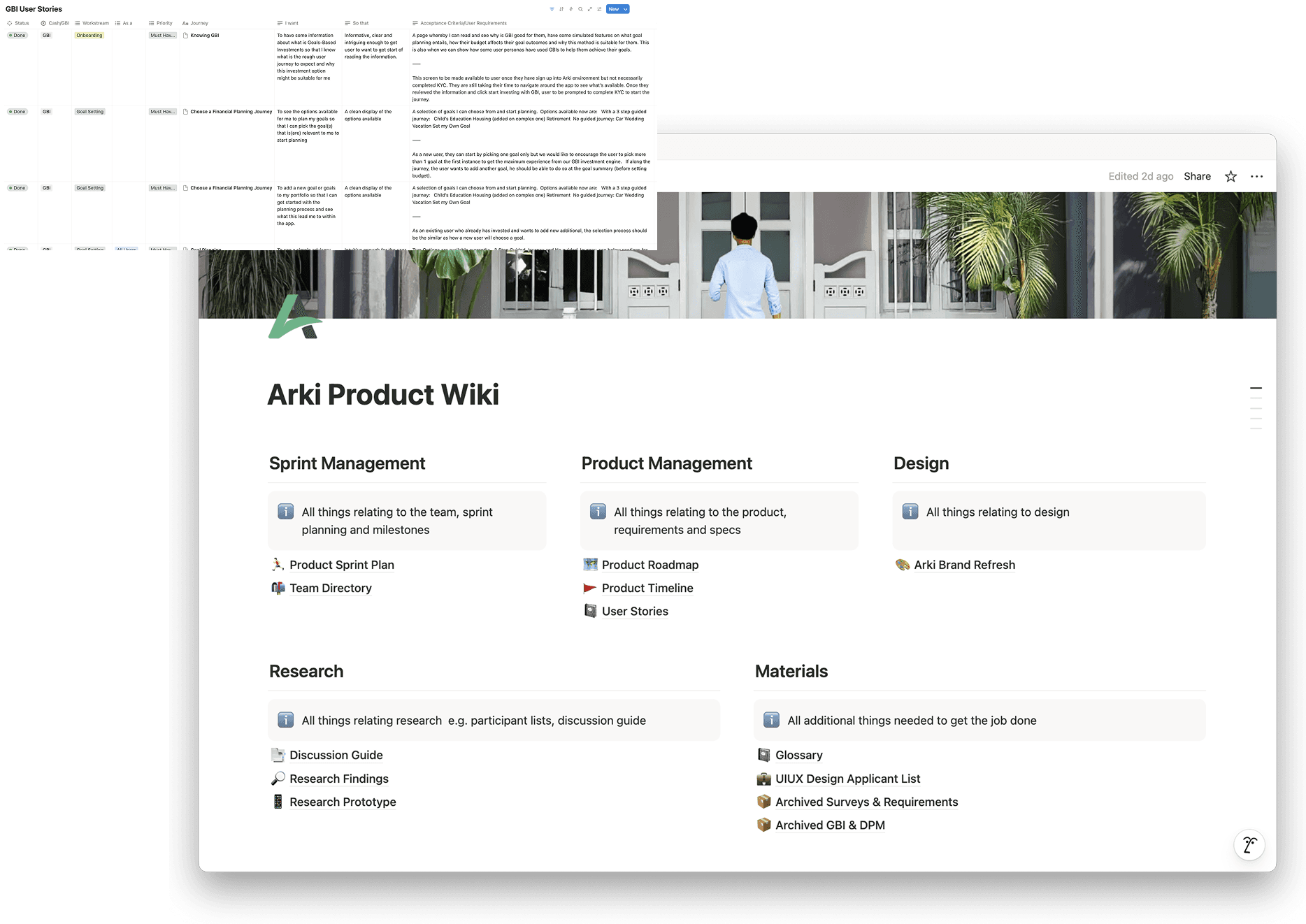
To manage scope, timelines, and constant change, I structured the project into clear workflows and phases. Creating a Notion Wiki, it houses all project related items including user story template to gather and prioritise requirements using MoSCoW method, discussion guides and track project sprints.
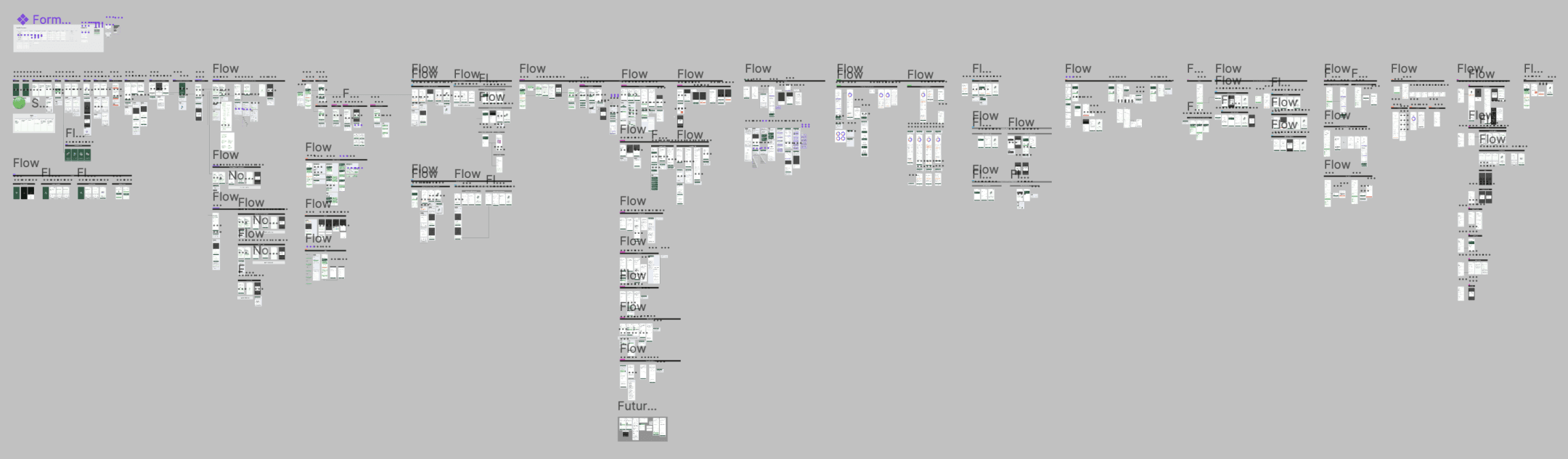
*Due to the project being under NDA, end-to-end wireframes can only be shown in-person
User & Business Needs
User & Business Needs
Arki aimed to serve the mass affluent segment. They are professionals with disposable income and long-term goals, but limited time or interest in complex investment products.
Arki aimed to serve the mass affluent segment. They are professionals with disposable income and long-term goals, but limited time or interest in complex investment products.
Primary Users: Mass Affluent
Business Goals
The hypothesis was that these users wanted:
A seamless way to plan and invest without speaking to a financial advisor
A product that felt smarter and more personalised than traditional robo-advisors
A design that instilled confidence and trust from the first interaction
Deliver a working MVP for public beta and investor pitching
Educate users on Arki’s goal-based investment philosophy (which differs from typical risk-based approaches)
Gain early feedback to test desirability, usability, and product-market fit
Business Goals
Primary Users:
Mass Affluent
Deliver a working MVP for public beta and investor pitching
Educate users on Arki’s goal-based investment philosophy
(which differs from typical risk-based approaches)Gain early feedback to test desirability, usability, and product-market fit
The hypothesis was that these users wanted:
A seamless way to plan and invest without speaking to a financial advisor
A product that felt smarter and more personalised than traditional robo-advisors
A design that instilled confidence and trust from the first interaction
The idea was simple: help people invest meaningfully toward real goals.
But turning that into a product when the backend wasn’t ready, meant rethinking how personalisation could look and feel.
The idea was simple: help people invest meaningfully toward real goals. But turning that into a product when the backend wasn’t ready, meant rethinking how personalisation could look and feel.
Here are some changes
I've made based on the user insights:
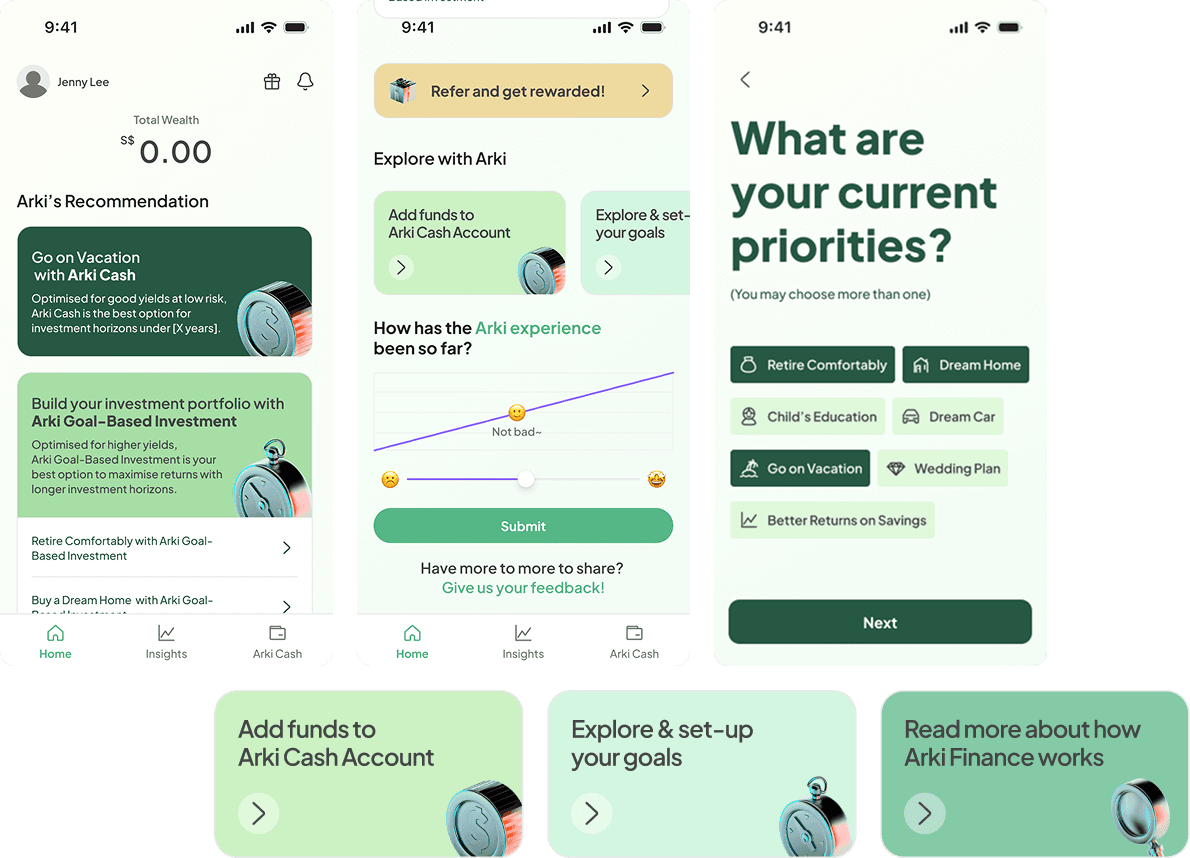
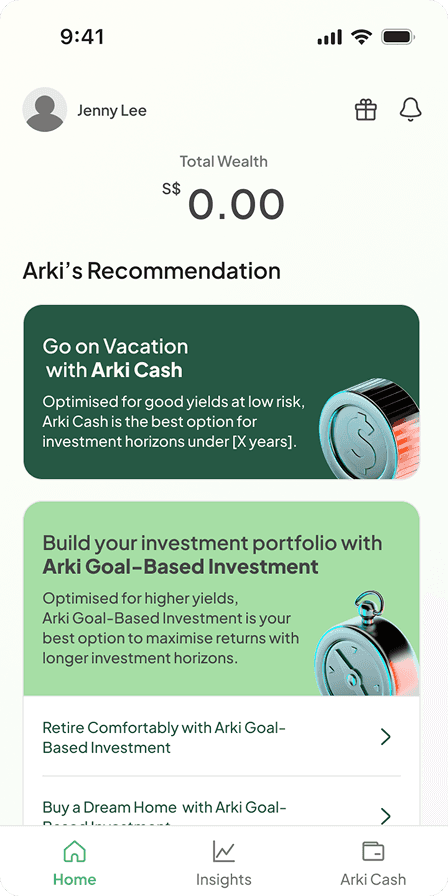
Anchoring recommendations to the dashboard
Design Rationale: Instead of funnelling users immediately into action
after onboarding (i.e. account setup & dynamic questionnaire),
I kept Arki’s investment recommendations pinned to the dashboard.
This acknowledged real behaviour as users often pause to explore,
reflect, or do research before committing. By keeping suggestions more prominent, we encouraged return engagement without pressure.
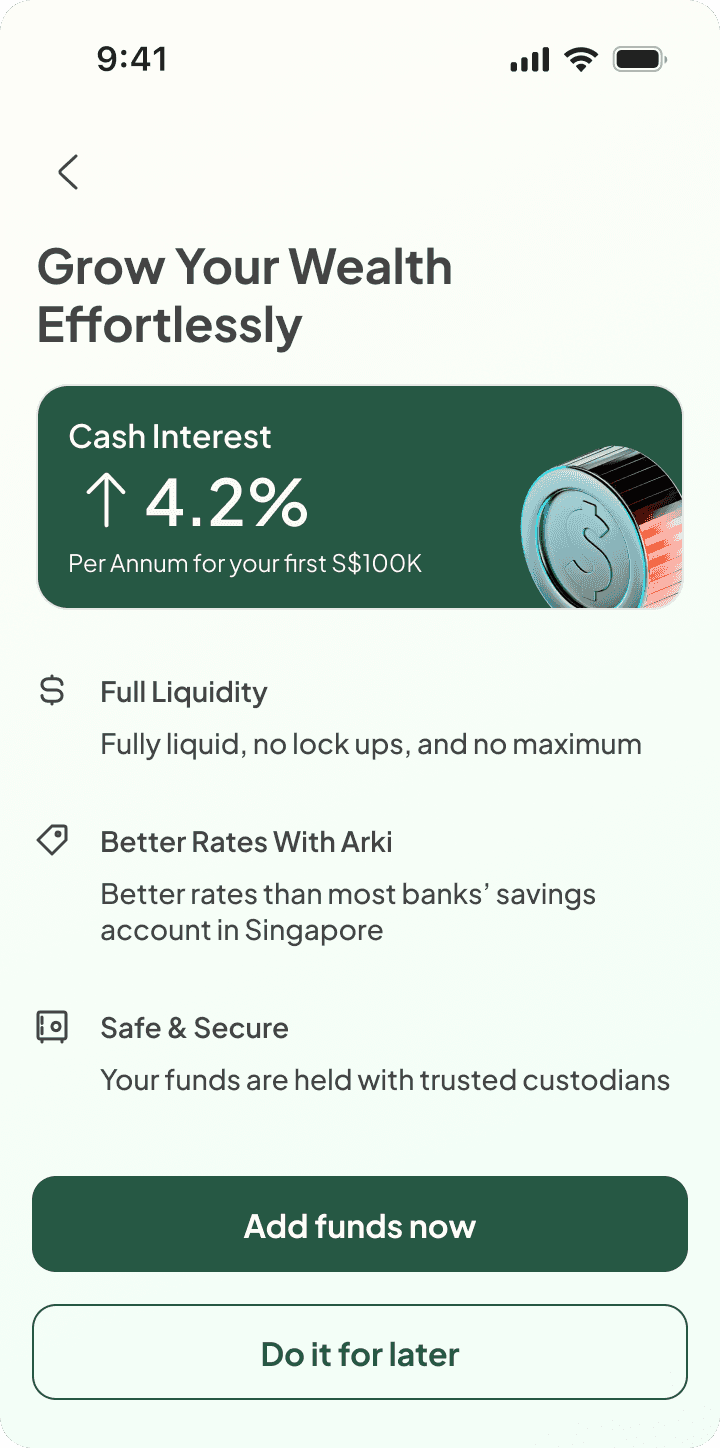
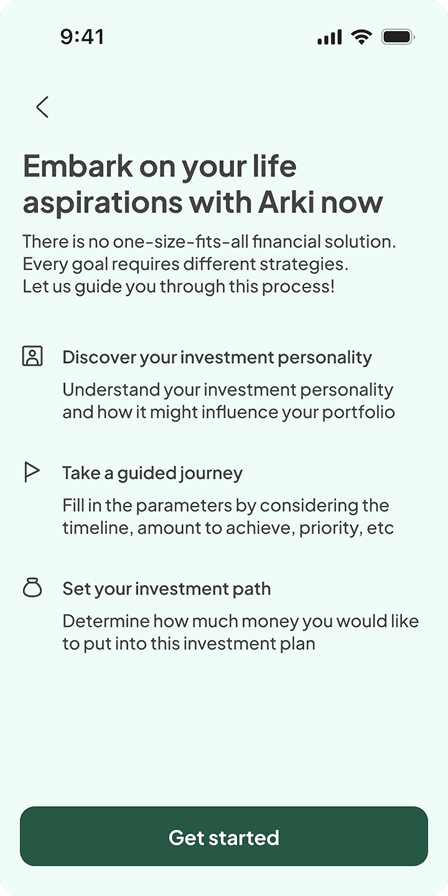
Setup explainer screens
Design Rationale: To reduce confusion, we introduced an explainer page before each investment and goal setup. This helped users anticipate what was coming and reduce drop-off.
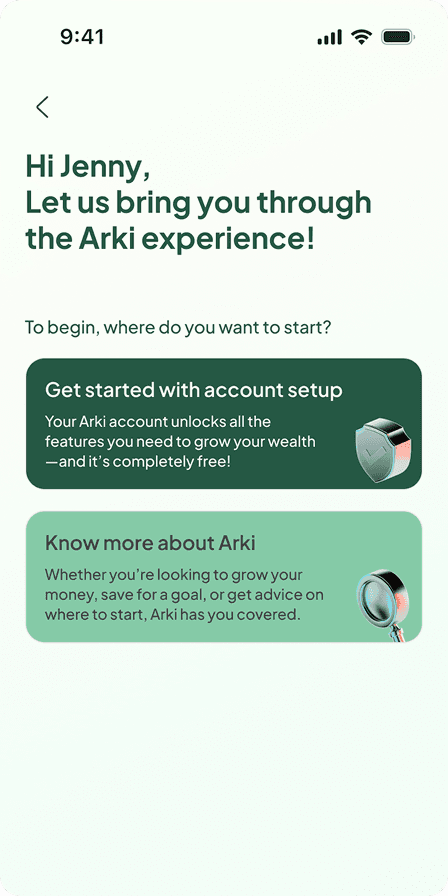
More human onboarding
Design Rationale: We made onboarding feel more conversational by asking for the user’s name and using it in subsequent steps. This added a layer of friendliness and personalisation from the start.
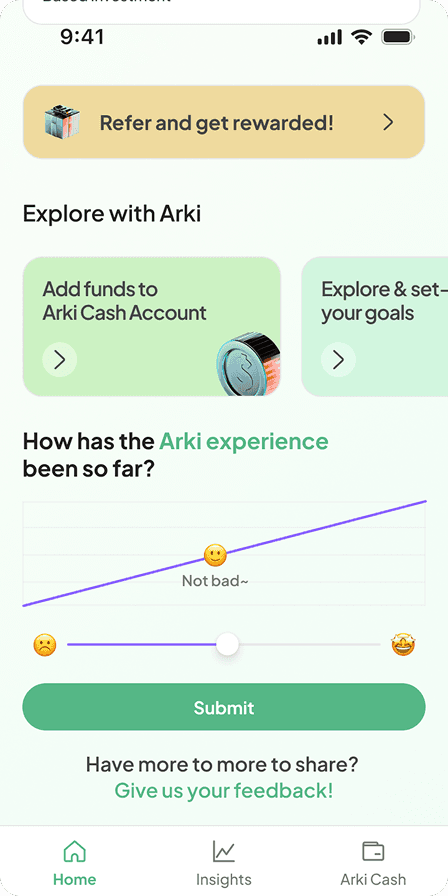
Engaging feedback module
Design Rationale: Since feedback was essential for early-stage iteration, a visually engaging module was created to collect user insights - making the act of giving feedback feel less transactional.

Here are some changes we made based on the user insights:
Anchoring recommendations to the dashboard
Design Rationale: Instead of funnelling users immediately into action after onboarding (i.e. account setup & dynamic questionnaire), I kept Arki’s investment recommendations pinned to the dashboard. This acknowledged real behaviour as users often pause to explore, reflect, or do research before committing. By keeping suggestions more prominent, we encouraged return engagement without pressure.
Setup explainer screens
Design Rationale: To reduce confusion, we introduced an explainer page before each investment and goal setup. This helped users anticipate what was coming and reduce drop-off.
More human onboarding
Design Rationale: We made onboarding feel more conversational by asking for the user’s name and using it in subsequent steps. This added a layer of friendliness and personalisation from the start.
Engaging feedback module
Design Rationale: Since feedback was essential for early-stage iteration, a visually engaging module was created to collect user insights - making the act of giving feedback feel less transactional.
What I Learned
Speak early, adapt often
Startups move fast, and clarity is rare. One of the biggest lessons was the importance of voicing concerns early and often. I had to push back on feature creep, guide stakeholders on realistic MVP goals, and explain the rationale behind design decisions while staying flexible and collaborative.
Think like a product owner
Wearing multiple hats taught me to think not just like a designer, but as a product owner. I constantly had to balance ideal UX with what was feasible, valuable, and buildable. More importantly, I learned that structure helps anchor teams, especially those new to product building by turning ambiguity into something more tangible, digestible, and executable.
What I Learned
Speak early, adapt often
Startups move fast, and clarity is rare. One of the biggest lessons was the importance of voicing concerns early and often. I had to push back on feature creep, guide stakeholders on realistic MVP goals, and explain the rationale behind design decisions while staying flexible and collaborative.Think like a product owner
Wearing multiple hats taught me to think not just like a designer, but as a product owner. I constantly had to balance ideal UX with what was feasible, valuable, and buildable. More importantly, I learned that structure helps anchor teams, especially those new to product building by turning ambiguity into something more tangible, digestible, and executable.
ABOUT
WORK
CONTACT
*Due to the project being under NDA, end-to-end wireframes can only be shown in-person
WANT TO KNOW MORE
ABOUT MY WORK?
DROP ME AN EMAIL AT ARISTA.KHOO@GMAIL.COM
WANT TO KNOW MORE
ABOUT MY WORK?
DROP ME AN EMAIL AT ARISTA.KHOO@GMAIL.COM
Supported internal funding through delivery of an end-to-end MVP
Beta launched in early 2025, achieving early traction with 100+ downloads and
5-star user ratings.
Supported internal funding through delivery of an end-to-end MVP
Beta launched in early 2025, achieving early traction with 100+ downloads and 5-star user ratings.
UX DESIGNER
&
STRATEGIST