Opportunity Marketplace
Opportunity Marketplace
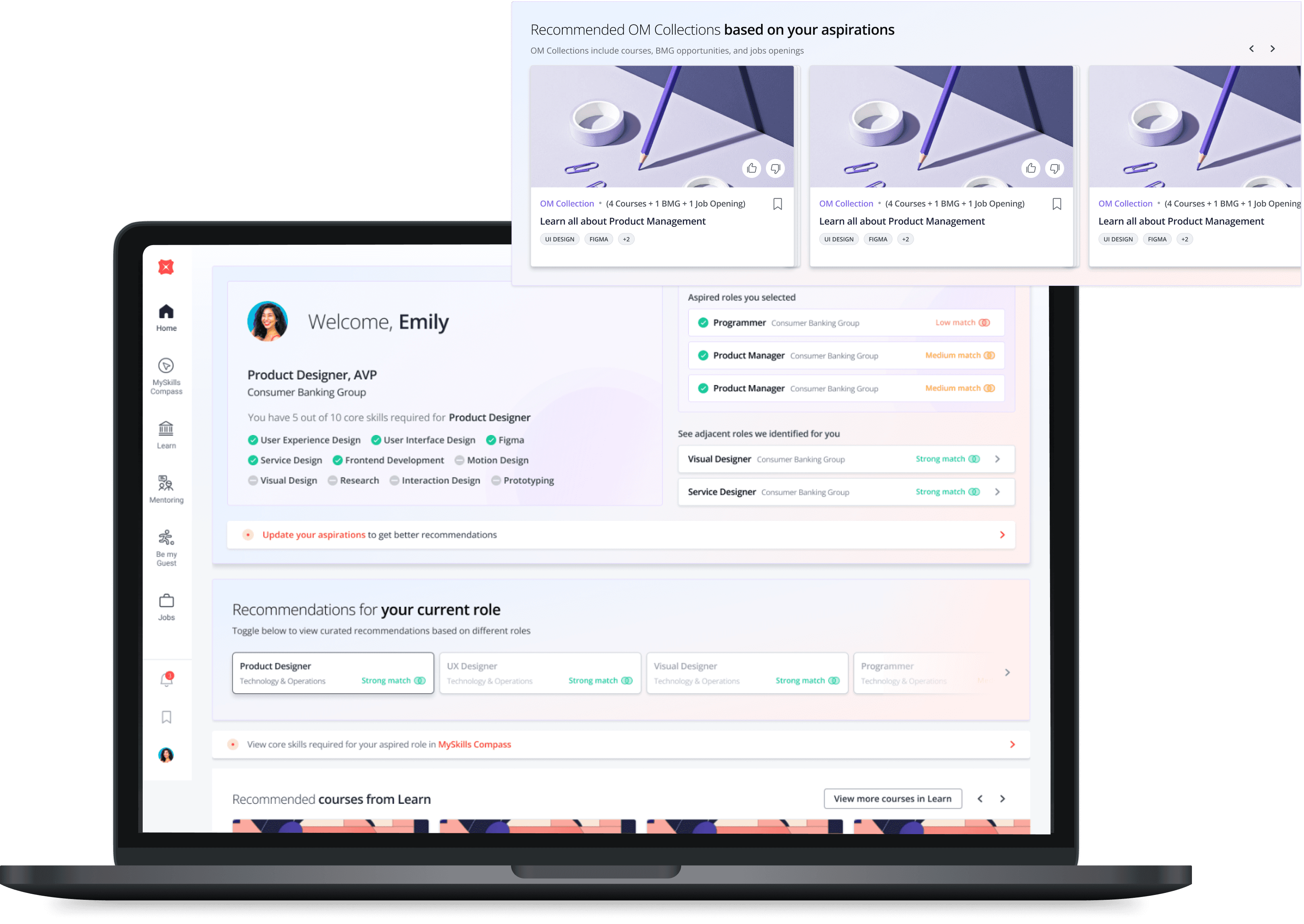
Opportunity Marketplace (OM) is a platform DBS uses to facilitate employees’ career and skills development. Our goal was to uncover employees’ core needs in navigating career development, and redesign the platform to better support and guide employees in their long-term career journey within the organisation.
Opportunity Marketplace (OM) is a platform DBS uses to facilitate employees’ career and skills development. Our goal was to uncover employees’ core needs in navigating career development, and redesign the platform to better support and guide employees in their long-term career journey within the organisation.
CLIENT: DBS
DBS
YEAR: 2022
2021
ROLE: DESIGN LEAD
DESIGN LEAD
The Problem
The Problem
Opportunity Marketplace had a low adoption rate among employees, as most did not see it as a tool to explore skills development and career progression pathways beyond internal mobility opportunities.
Opportunity Marketplace had a low adoption
rate among employees, as most did not see it
as a tool to explore skills development and
career progression pathways beyond internal
mobility opportunities.
The design team had less than a month to plan and run the workshop, gather requirements, prioritise backlogs, and design key features.
The design team had less than a month to plan and run the workshop, gather requirements, prioritise backlogs, and design key features.
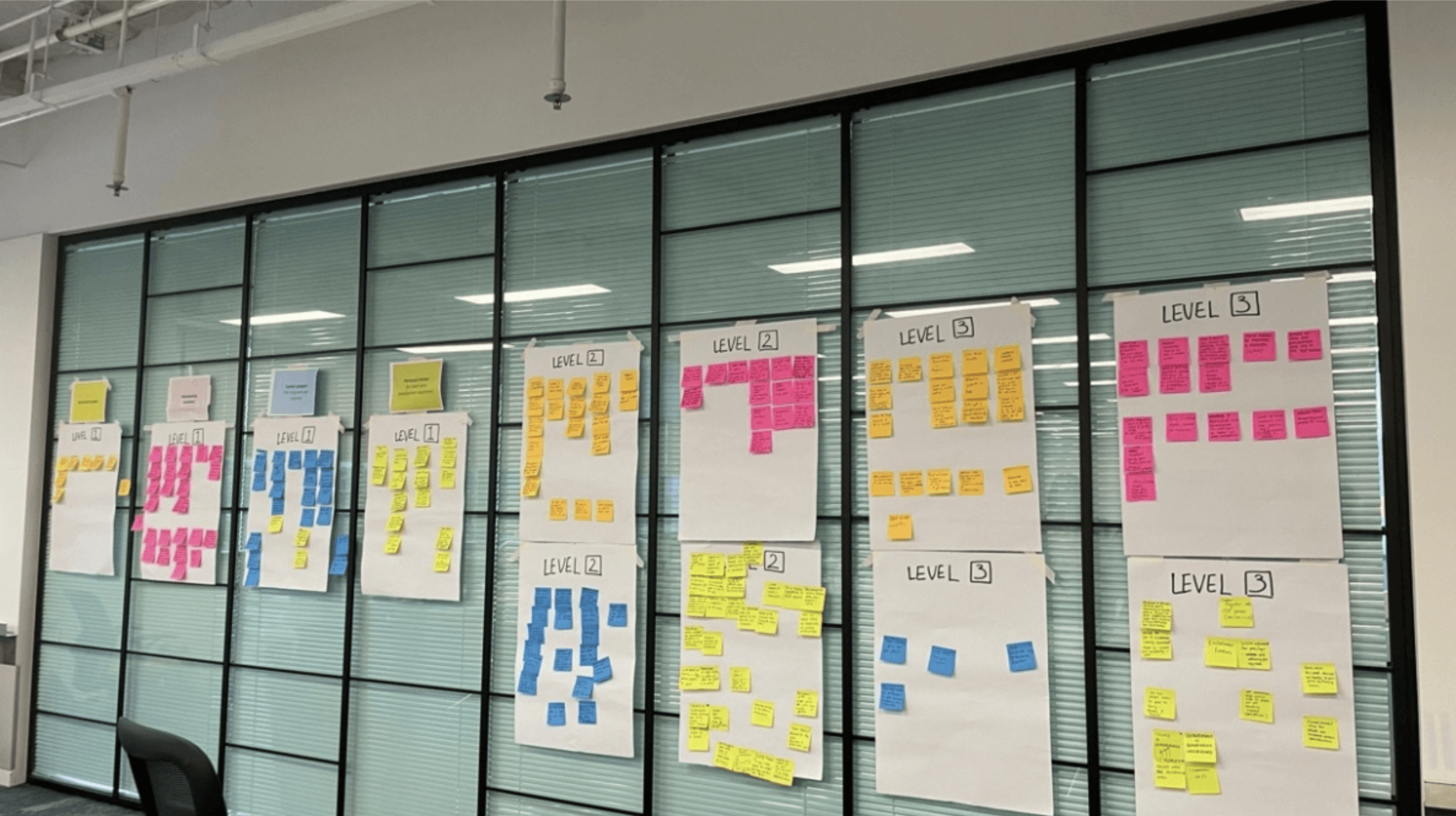
As the lead designer, I facilitated a define workshop with the DBS team to:
Ideate both immediate solutions and blue-sky visions of how OM can support employees’ career journeys
Align and understand the DBS team’s inclination for OM’s overall direction
Prioritise high-value and feasible ideas to be incorporated into the design backlog
As the lead designer, I facilitated a define workshop with the DBS team to:
Ideate both immediate solutions and blue-sky visions of how OM can support employees’ career journeys
Align and understand the DBS team’s inclination for OM’s overall direction
Prioritise high-value and feasible ideas to be incorporated into the design backlog
User & Business Needs
Through interviews with 36 DBS employees and a collaborative define workshop, we uncovered what employees need to support and guide their long-term career journey within the organisation, aligning these insights with the client’s business objectives.
Primary Users: DBS Employees
Their needs:
Identify areas to explore, skills to develop, and potential career progression pathways
Receive recommendations for training tailored to their individual needs
Explore diverse roles and understand the skills required for those roles
Business Goals
Empower employees to explore related job roles and skills
Help employees understand their current position in their career development
Encourage individuals to take ownership of their career planning
User & Business Needs
Through interviews with 36 DBS employees and a collaborative define workshop, we uncovered what employees need to support and guide their long-term career journey within the organisation, aligning these insights with the client’s business objectives.
Primary Users: DBS Employees
Their needs:
Identify areas to explore, skills to develop, and potential career progression pathways
Receive recommendations for training tailored to their individual needs
Explore diverse roles and understand the skills required for those roles
Business Goals
Empower employees to explore related job roles and skills
Help employees understand their current position in their career development
Encourage individuals to take ownership of their career planning
Here are some design I've
made based on user insights:
Clarity drives action
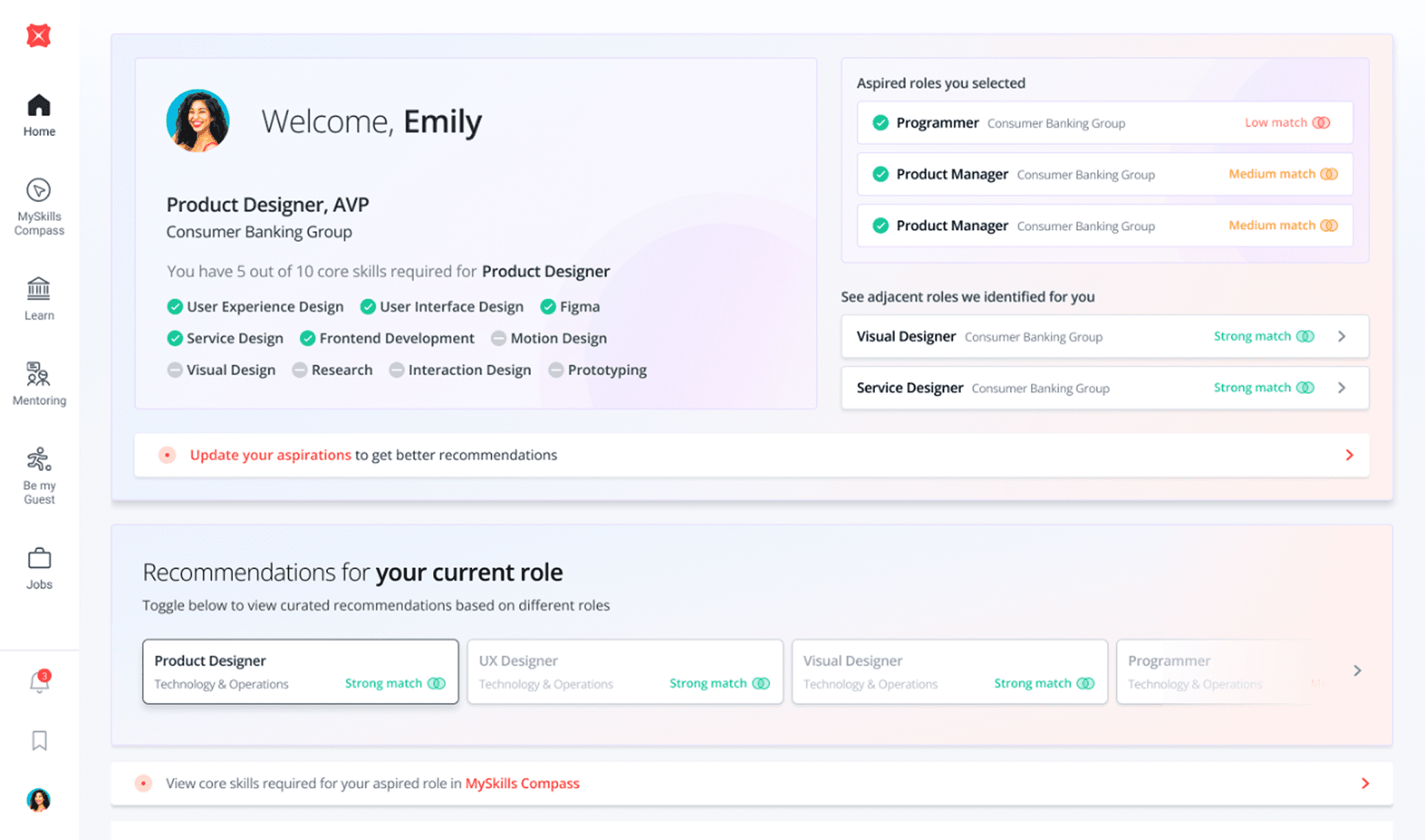
Employees need a quick way to understand their current skills, gaps, and available opportunities without navigating multiple pages.
Design Changes: Designed a dashboard that provides a clear overview of key information and acts as a central entry point. Employees can easily view required skills for their role, identify gaps, explore other roles, and access recommended content.
Structured guidance
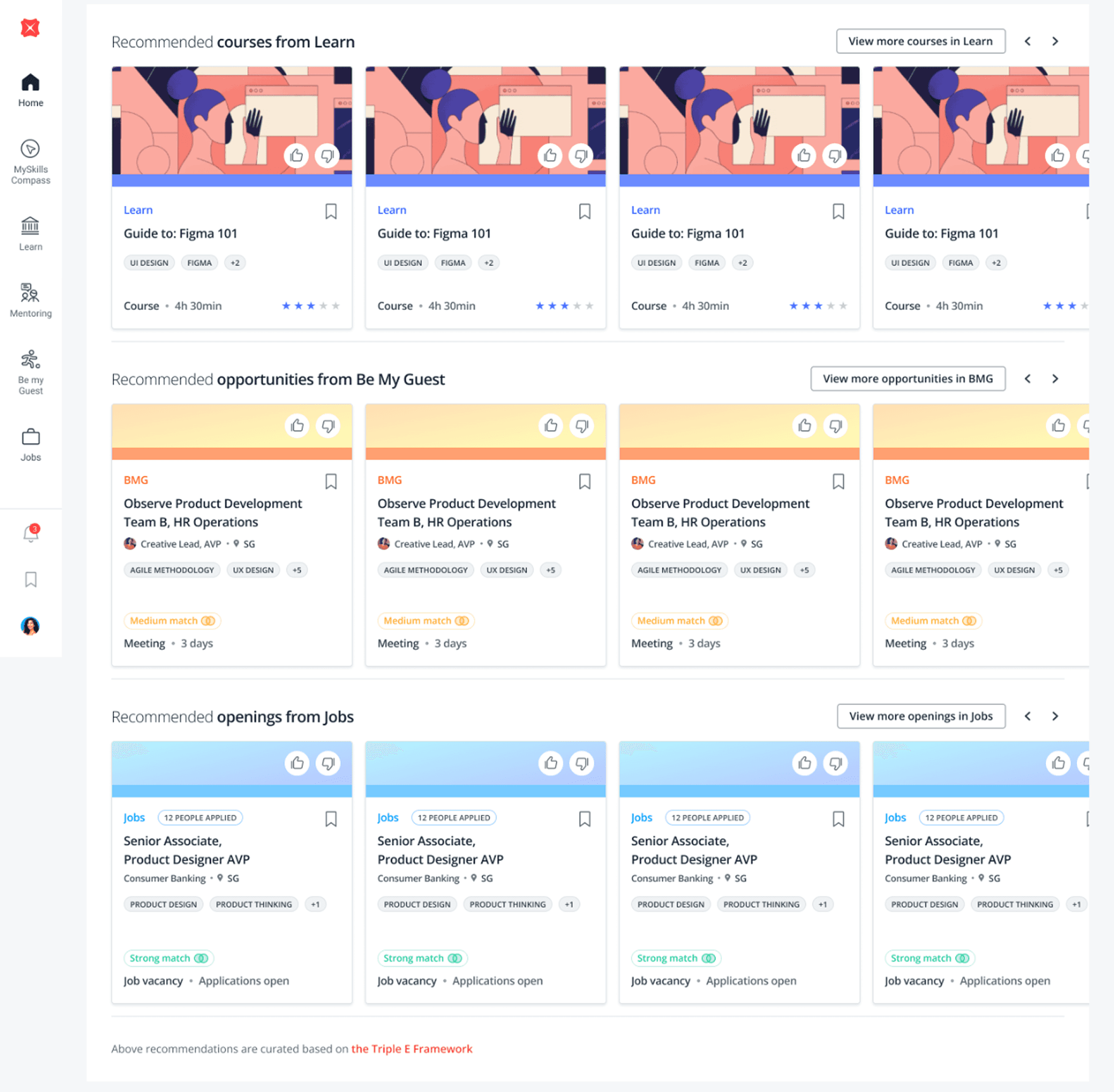
Employees want relevant recommendations that support their career growth in a structured way.
Design Changes: Introduced personalised content aligned to the employee’s current or explored roles, curated based on DBS’ Triple E approach—Education, Exposure, and Experience. This allows employees to learn through courses, gain exposure through programmes like “Be My Guest”, or explore new roles internally.
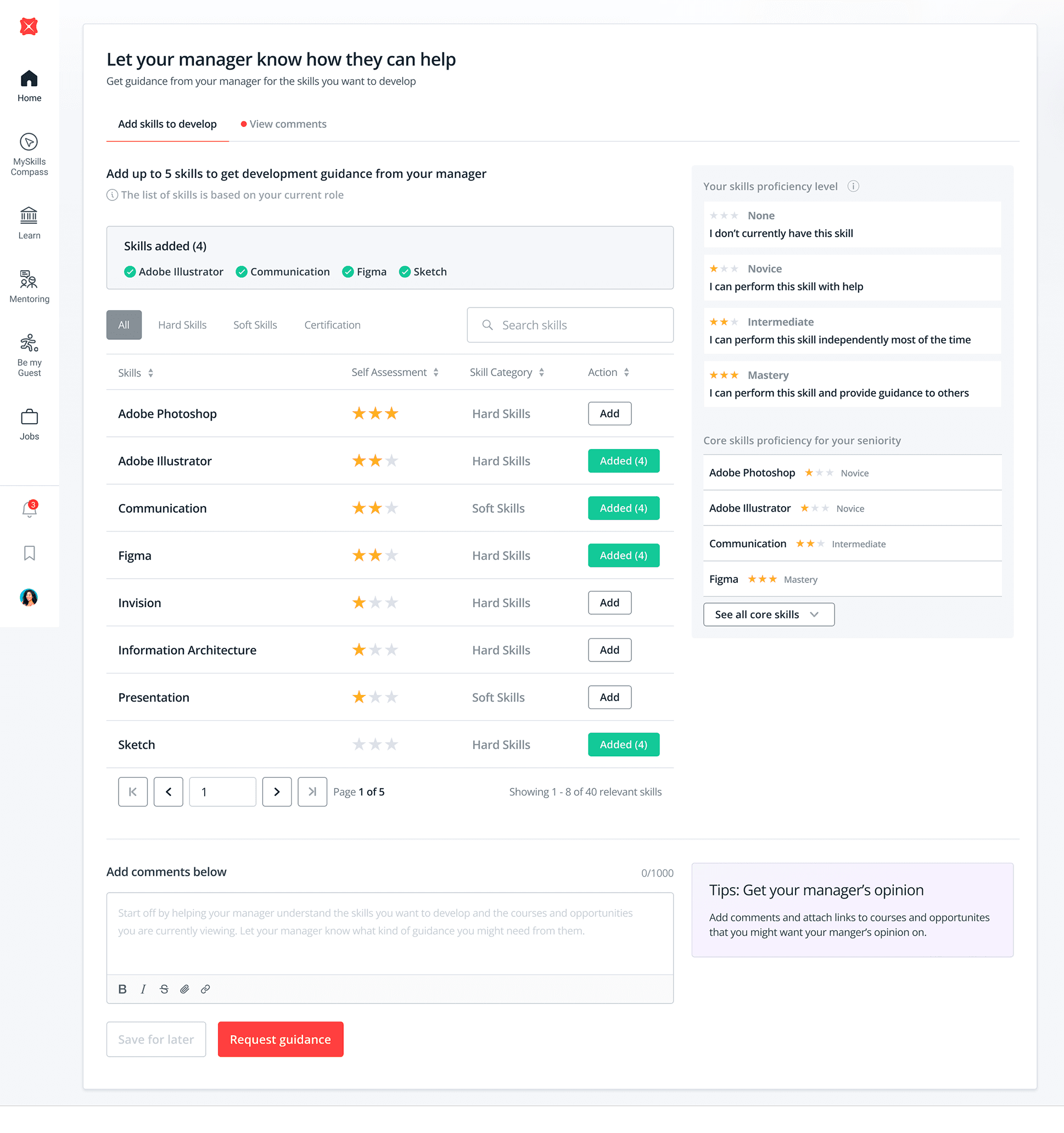
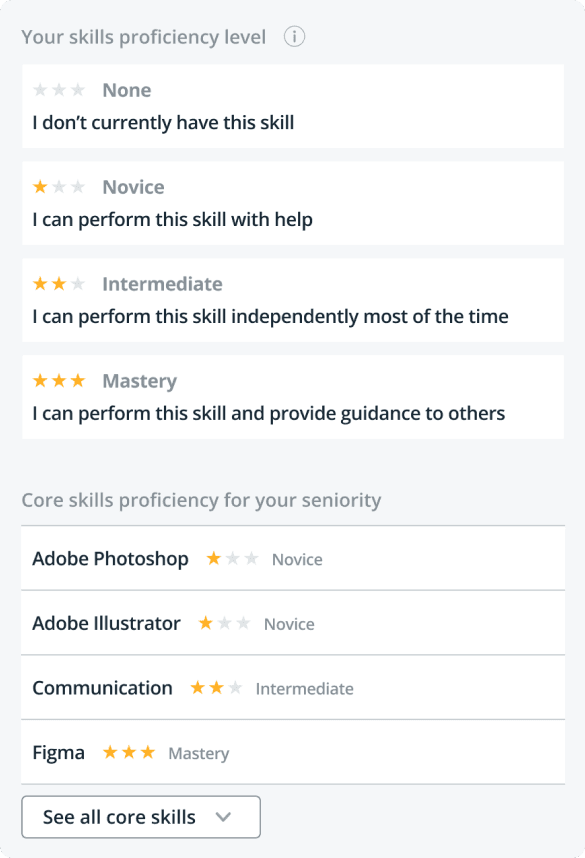
Make self-assessment easier
Employees need clearer guidance to assess their skill proficiency without second-guessing themselves.
Design Changes: Redefined skill metrics and introduced “core skills proficiency for your seniority” as a benchmark. This helps employees evaluate their current level more accurately and understand expectations for growth.
Lower barrier to take action on development
Employees need an easier way to initiate conversations and take ownership of their career growth.
Design Changes: Created a structured flow for employees to add, rate, and prioritise skills they want to develop, and send requests for guidance. This removes friction in reaching out, improves visibility for managers, and encourages more proactive engagement from employees.
Here are some design
I've made based on
user insights:
Clarity drives action
Employees need a quick way to understand their current skills, gaps, and available opportunities without navigating multiple pages.
Design Changes: Designed a dashboard that provides a clear overview of key information and acts as a central entry point. Employees can easily view required skills for their role, identify gaps, explore other roles, and access recommended content.
Structured guidance
Employees want relevant recommendations that support their career growth in a structured way.
Design Changes: Introduced personalised content aligned to the employee’s current or explored roles, curated based on DBS’ Triple E approach—Education, Exposure, and Experience. This allows employees to learn through courses, gain exposure through programmes like “Be My Guest”, or explore new roles internally.
Lower barrier to take action on development
Employees need an easier way to initiate conversations and take ownership of their career growth.
Design Changes: Created a structured flow for employees to add, rate, and prioritise skills they want to develop, and send requests for guidance. This removes friction in reaching out, improves visibility for managers, and encourages more proactive engagement from employees.
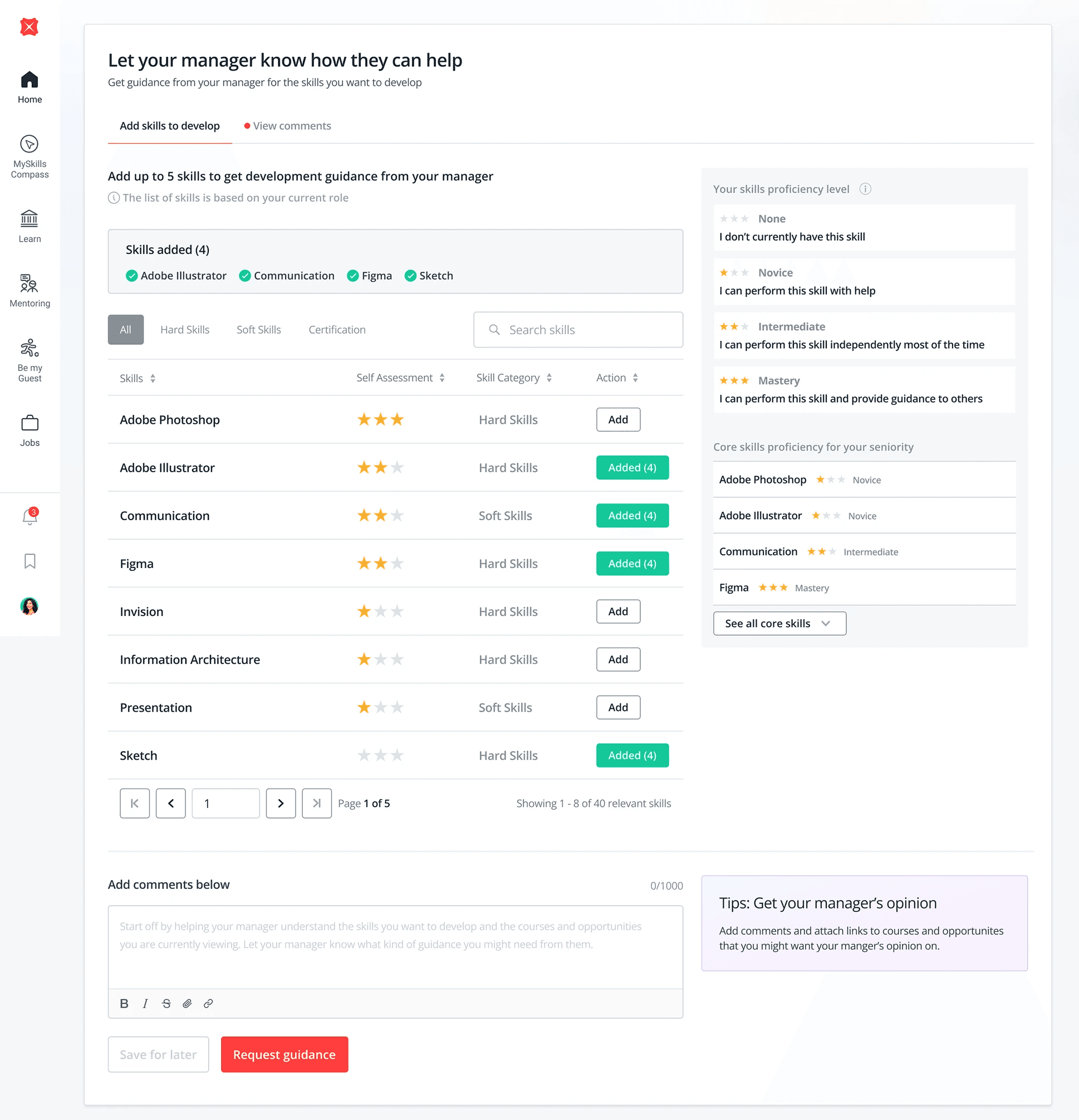
Make self-assessment easier
Employees need clearer guidance to assess their skill proficiency without second-guessing themselves.
Design Changes: Redefined skill metrics and introduced “core skills proficiency for your seniority”
as a benchmark. This helps employees evaluate their current level more accurately and understand expectations for growth.
What I Learned
Working within a compressed two-week timeline, I learned how to bring structure and focus to ambiguity. I designed and facilitated workshops with HR stakeholders to align on problem statements, guide ideation, and translate broad, often tangential ideas into actionable design directions.
Balancing business constraints, research-backed archetypes, and the organisation’s career development framework, I had to quickly synthesise inputs into clear priorities and design outputs. This experience strengthened my ability to lead non-design stakeholders through structured thinking, while ensuring that outcomes remained grounded, feasible, and aligned with both user needs and business goals.
WANT TO KNOW MORE
ABOUT MY WORK?
DROP ME AN EMAIL AT ARISTA.KHOO@GMAIL.COM
What I Learned
Working within a compressed two-week timeline,
I learned how to bring structure and focus to ambiguity.
I designed and facilitated workshops with HR stakeholders to align on problem statements, guide ideation, and translate broad, often tangential ideas into actionable design directions.
Balancing business constraints, research-backed archetypes, and the organisation’s career development framework, I had to quickly synthesise inputs into clear priorities and design outputs. This experience strengthened my ability to lead non-design stakeholders through structured thinking, while ensuring that outcomes remained grounded, feasible, and aligned with both user needs and business goals.
WANT TO KNOW MORE
ABOUT MY WORK?
DROP ME AN EMAIL AT ARISTA.KHOO@GMAIL.COM
UX DESIGNER
&
STRATEGIST